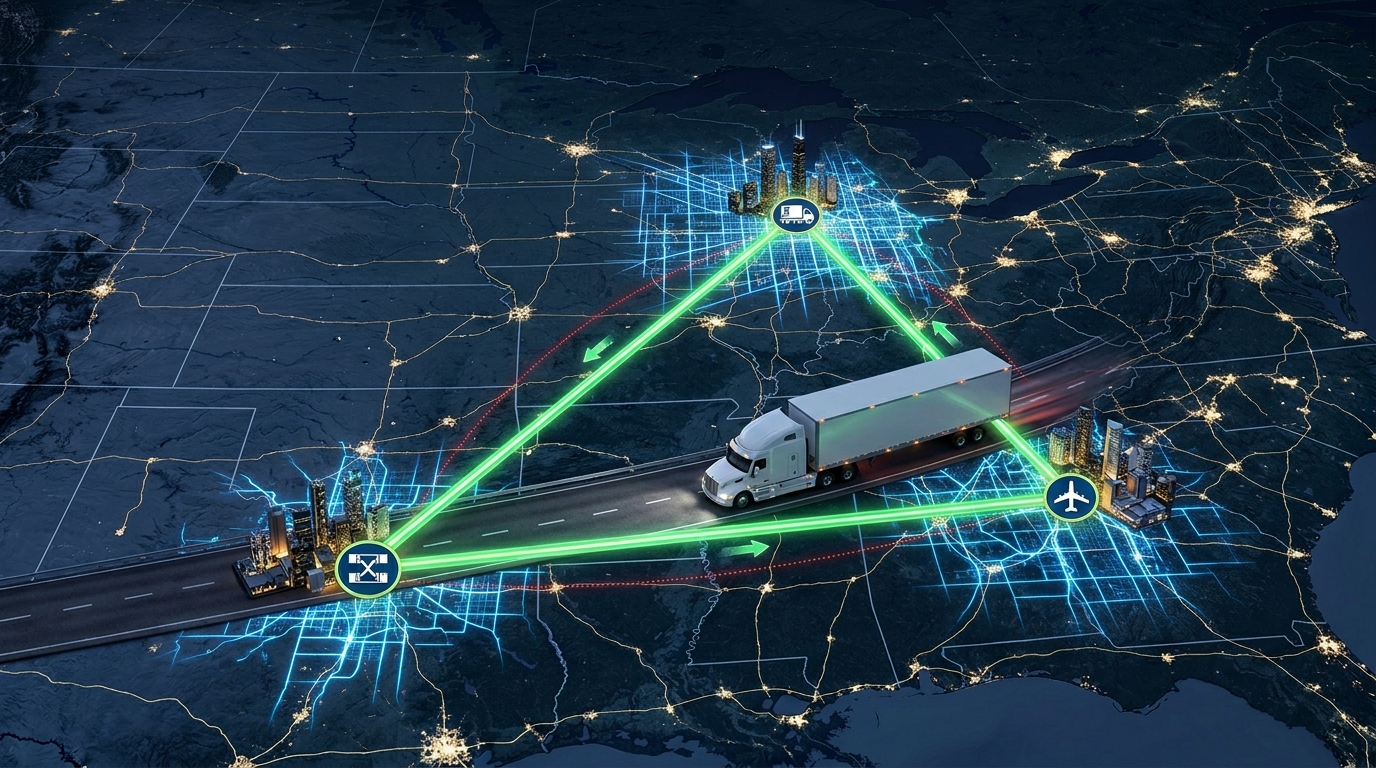
Let’s talk about the silent killer of trucking businesses: Deadhead.
You can negotiate the highest Rate Per Mile (RPM) on the planet. You can run the most fuel-efficient truck ever built. But if you are driving empty for 300 miles to pick up your next load, your net profit is bleeding out onto the highway.
“Deadhead is not a necessary evil. It is a sign of lazy dispatching and poor planning. Every empty mile you drive is a mile you are actively paying the market to let you exist.”
The industry average for deadhead miles hovers dangerously around 15% to 20%. That means for every 100,000 miles an owner-operator drives in a year, they are running empty for 20,000 of them. At an operating cost of $1.50 per mile, that is $30,000 literally burned in fuel, wear and tear, and time.
In this guide, we will break down Triangle Routing—the exact strategy Empire Dispatch uses to keep our clients’ deadhead ruthlessly below 10%, maximizing their gross and padding their net profit.
What is Triangle Routing?
Most independent owner-operators operate on what we call “Ping-Pong Routing.” They book a load from Point A to Point B. Once they get unloaded at Point B, they pull up the DAT board and scramble to find a load going back to Point A (or anywhere else that pays well).
Here is why Ping-Pong Routing fails:
- Market Imbalance: Point A might be a great manufacturing hub, but Point B might be a consumer dead-zone. Loads going from A to B pay great ($3.50/mile), but loads coming back from B to A pay garbage ($1.20/mile).
- Desperation: When you are empty in a bad market, brokers know it. You lose all negotiating leverage. You end up taking a cheap load just to cover fuel, or you deadhead 400 miles to a better market.
Triangle Routing is the strategic planning of three sequential loads (A → B → C → A) before the truck ever leaves Point A. Instead of just looking for a return trip, you map out a triangular (or polygonal) path through consistently hot freight markets, ensuring you never get trapped in a dead zone.
The Anatomy of a Perfect Triangle
Building a profitable triangle requires understanding regional freight dynamics. Let’s look at a classic Midwest/Southeast triangle example for a Dry Van.
Leg 1: The Headhaul (Chicago, IL to Atlanta, GA)
You start in a massive freight hub. The outbound rates are solid. You book a load paying $2.80 a mile. This is your moneymaker leg.
Leg 2: The Repositioning (Atlanta, GA to Charlotte, NC)
Instead of trying to fight for a cheap $1.60/mile backhaul directly from Atlanta to Chicago, you look sideways. You book a short, regional run from Atlanta to Charlotte, NC. The rate might be average ($2.20/mile), but it only takes one day and puts you in an entirely different, stronger freight market for the return trip.
Leg 3: The Strong Backhaul (Charlotte, NC back to Chicago, IL)
Charlotte has a high volume of manufactured goods heading back to the Midwest. Because you positioned yourself correctly in Leg 2, you are now able to command a strong $2.50/mile rate back home.
The Ping-Pong Result: A → B ($2.80) + B → A ($1.60) = $2.20 Average RPM.
The Triangle Result: A → B ($2.80) + B → C ($2.20) + C → A ($2.50) = $2.50 Average RPM.
By simply adding a third point to the route, you increased your weekly average by $0.30 per mile, effectively putting hundreds of extra dollars in your pocket for the exact same amount of driving time.
The Three Rules of Triangle Routing
If you want to implement this strategy, you must adhere to three strict rules.
Rule 1: Never Book Leg 1 Without Seeing Leg 2
Do not accept a load into a market without immediately checking the DAT Load-to-Truck ratio for outbound freight in that destination. If a broker offers you $4.00 a mile to go to South Florida in November, they are paying you that much because there is zero freight coming out. If you take it, you will have to deadhead back to Jacksonville or Atlanta to find your next load.
Rule 2: Know Your “Bailout” Radius
A “bailout” is the maximum distance you are willing to deadhead from a delivery point to a new pickup point. At Empire Dispatch, we aggressively try to keep bailouts under 75 miles. If a delivery puts you 200 miles away from the nearest decent freight hub, the rate on that inbound load needs to be astronomically high to justify the empty miles.
Rule 3: Build Relationships on the Points
Triangle routing becomes infinitely more profitable when you run the same triangles consistently. If you run the Chicago-Atlanta-Charlotte triangle every two weeks, you start to learn the specific brokers who control the best freight in those lanes. You bypass the spot market altogether and start securing dedicated, recurring loads.
Why Most Owner-Operators Can’t Do This (And Why You Need Empire Dispatch)
In theory, triangle routing sounds easy. In practice, it is incredibly difficult for a solo driver to execute.
Why? Because it requires massive time and focus. You cannot safely drive a 80,000-pound truck down the interstate while simultaneously calling three different brokers, negotiating rates, checking credit scores, and timing pickup appointments so that Leg 2 perfectly aligns with the delivery of Leg 1.
When owner-operators try to do this themselves, they usually end up sitting in a truck stop for two days waiting on a load to line up, which completely destroys their weekly gross.
This is the exact problem Empire Dispatch solves.
When you partner with us, you are getting an entire back-office team. While you are driving Leg 1, we are already negotiating Leg 2 and Leg 3. We use advanced DAT analytics to map out the heat zones, ensure your deadhead stays under 10%, and handle 100% of the carrier packets and rate confirmations.
You don’t just drive point-to-point anymore. You execute precision logistics.
Leave a Reply