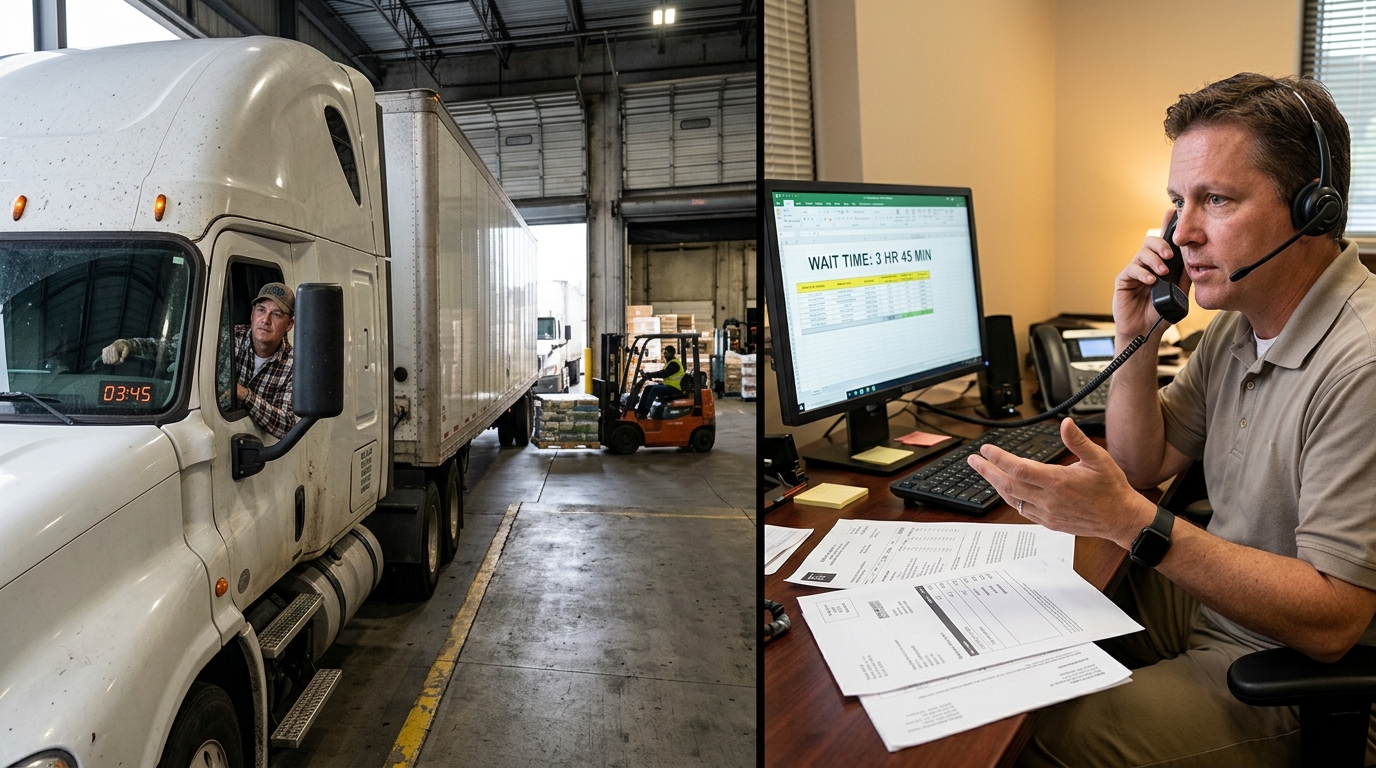
There are few things in the trucking industry more infuriating than backing into a dock at 8:00 AM for a scheduled appointment, only to be told by a forklift driver holding a clipboard that they “are running a little behind.” Six hours later, you are still sitting there. Your Hours of Service (HOS) clock is bleeding out. Your next load is in jeopardy.
And when you finally get empty and demand compensation for your lost time, the broker hits you with the classic line: “Sorry, the shipper didn’t approve the detention.”
“If your truck is not moving, it is not generating revenue. But your fixed costs—your insurance, your truck payment, your time—are still ticking. A shipper holding you hostage at a dock without paying you is literally stealing from your business.”
In this no-nonsense guide, we are going to outline exactly what Detention Pay is, why brokers constantly try to worm out of paying it, and the aggressive protocols Empire Dispatch uses to force brokers to pay you for every single hour they waste.
The Definition of Detention Pay
In the standard freight industry, a carrier is granted a “free time” window at the shipper (pickup) and the receiver (delivery). Historically, this free time is two hours from the time of your scheduled appointment (or two hours from your arrival time if it is a First-Come, First-Serve facility).
If you are held at the facility for 2 hours and 1 minute, you are now officially in Detention. The industry standard rate for detention pay is usually between $40 to $60 per hour, prorated to the 15-minute mark. For specialized equipment like Reefers or Heavy Haul, it should be significantly higher.
Why Brokers Refuse to Pay It
Brokers hate paying detention. They hate it because it requires them to go back to their customer (the shipper or receiver), admit there was an inefficiency, and ask for more money. Shippers hate admitting fault, so they often reject the broker’s request. Instead of fighting their customer, the broker takes the path of least resistance: they deny your claim.
They will use every loophole in the contract to deny you:
- “You didn’t notify us exactly 30 minutes before the free time expired.”
- “Your in-and-out times weren’t signed by the receiver.”
- “You arrived 15 minutes late for your appointment, which voids the detention clause.”
The Empire Protocol: How to Make Them Pay
If you want to get paid for your time, you cannot rely on the broker’s goodwill. You must build an absolute, bulletproof paper trail from the moment you hit the guard shack. Here is the strict protocol Empire Dispatch enforces on every single load.
1. The Arrival Notification (The Timestamp)
The clock does not start when you bump the dock. The clock starts the second you arrive at the facility. As soon as you hit the guard shack, you (or your dispatcher) must notify the broker via email or tracking app. A phone call is utterly useless because it leaves no paper trail.
Empire Dispatch Action: We send an electronic timestamped notification to the broker the minute you arrive. We establish the official start of the two-hour clock in writing.
2. The 90-Minute Warning (The Threat)
Brokers require notification before you go into detention. If you wait until hour 3 to complain, they will deny the claim on a technicality.
Empire Dispatch Action: At exactly 90 minutes of wait time, we send the broker a “Detention Warning” email. We inform them that free time expires in 30 minutes, and that detention will begin accruing at $50/hour immediately thereafter. This forces the broker to call the shipper and light a fire under the warehouse manager.
3. The Bill of Lading (The Ironclad Proof)
The only document that matters in a court of law or a freight claim is the Bill of Lading (BOL). When you are finally loaded or unloaded, you MUST have the shipping clerk write your precise arrival time and your precise departure time on the BOL, and they MUST sign next to it.
If the clerk refuses to sign your times, you write: “Clerk refused to sign arrival/departure times. Arrived at 0800. Departed at 1400.” and sign it yourself.
4. The Immediate Invoice Submission
Most rate confirmations state that detention requests must be submitted within 24 hours of delivery. If you wait until you get home on the weekend to send your paperwork, you forfeit your money.
Empire Dispatch Action: The second you send us a picture of the signed BOL showing the delay, we generate a formal Detention Invoice and submit it to the broker immediately alongside the linehaul invoice. We do not wait.
Negotiating the Rate Confirmation (Pre-Emptive Strikes)
The real battle for detention pay happens before you ever pick up the load. It happens during the Rate Confirmation negotiation.
Many broker rate confirmations have predatory clauses hidden in the fine print. Clauses like: “Maximum detention payout is $150 regardless of wait time.” Or, “Detention is only paid if the shipper agrees to pay it.”
When an owner-operator books a load themselves while driving, they usually sign the rate con blindly on their phone. At Empire Dispatch, we read the fine print. If a broker has a predatory detention clause, we strike it out and send it back, demanding standard $50/hour uncapped detention, or we don’t take the load.
Your Time Is Your Most Valuable Asset
If you allow shippers to hold you up for four hours on a Tuesday, you might miss your Wednesday morning pickup. That one delay just cost you an entire day of revenue, and the $100 in detention pay they might give you won’t even cover the fuel you burned idling.
Detention pay isn’t just about getting an extra fifty bucks. It’s about establishing boundaries. It’s about letting the market know that your truck is a premium asset, and if they waste your time, they are going to pay for it dearly.
Leave a Reply