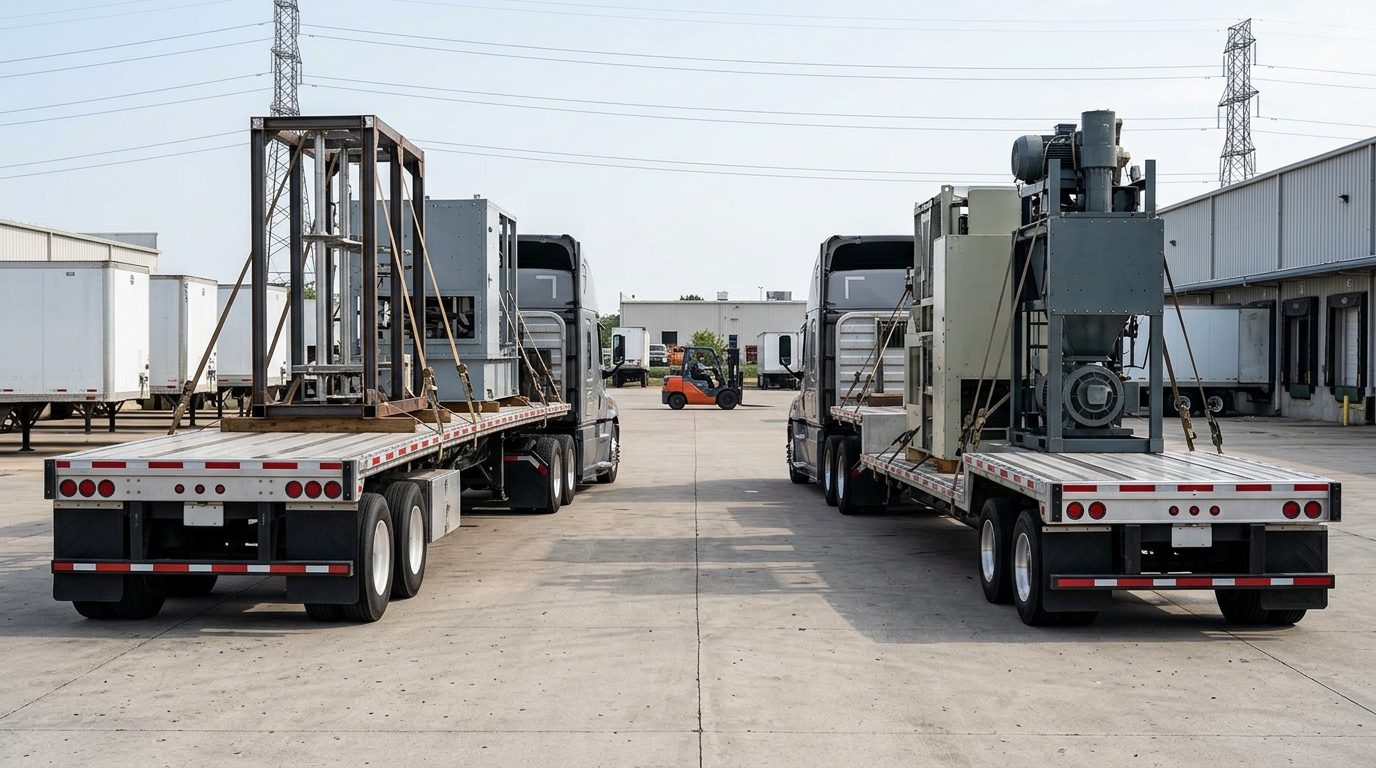
The Open-Deck Dilemma
When owner-operators decide to enter the open-deck trucking market, the most common question is: “Should I buy a standard flatbed or invest in a step-deck (drop-deck) trailer?” Both trailers serve critical roles in the heavy haul and specialized freight industries, but they cater to different types of freight, command different rates, and require different operational strategies. Understanding the nuances between step deck vs flatbed rates is critical for maximizing your profitability in heavy haul dispatch.
Making the wrong equipment choice can leave you hauling cheap freight on a more expensive trailer, while making the right choice can unlock access to lucrative, specialized markets that standard trailers simply cannot touch.
The Standard Flatbed: The Versatile Workhorse
A standard flatbed is typically 48 to 53 feet long and sits approximately 60 inches off the ground. It is the undisputed workhorse of the American infrastructure system.
Advantages of a Standard Flatbed:
- Volume of Freight: Flatbeds have access to a massive volume of standard commodities. Lumber, steel coils, building materials, and PVC piping are constantly moving. You will rarely struggle to find a load on a flatbed load board.
- Lower Initial Cost: Standard flatbeds are significantly cheaper to purchase and maintain than specialized drop-deck trailers.
- Continuous Deck Space: The unbroken, flat surface allows for easy loading of long, rigid materials like massive steel I-beams or 50-foot pipes.
The Rate Reality:
Because standard flatbeds are the most common open-deck trailer, the market is highly competitive. Rates are solid, but they are subject to intense downward pressure during economic slowdowns or housing market slumps. To make a premium on a flatbed, you must aggressively negotiate accessorials (like tarp pay) or be willing to haul in undesirable regions.
The Step-Deck: Specialized and Lucrative
A step-deck (or drop-deck) trailer features an upper deck (usually 10-11 feet long) and a lower deck that drops down to sit roughly 36 to 40 inches off the ground. This drop is the defining feature that changes the entire economic model of the trailer.
Advantages of a Step-Deck:
- Taller Freight Capabilities: The maximum legal height for a loaded vehicle in most states is 13 feet, 6 inches. Because a standard flatbed sits 5 feet high, it can only haul freight up to 8’6″ tall without requiring an “oversize” permit. A step-deck’s lower deck allows it to haul freight up to 10 feet tall legally. This is massive.
- Access to Heavy Machinery: Construction equipment, massive generators, and agricultural machinery (tractors, combines) are typically tall. A step-deck can haul these without triggering expensive and time-consuming oversize regulations.
- Easier Loading with Ramps: Many step-decks can be equipped with ramps, allowing wheeled equipment to be driven directly onto the trailer, bypassing the need for a crane or heavy forklift.
The Rate Reality:
Because a step-deck can haul taller, specialized freight, it generally commands a higher Rate Per Mile (RPM) than a standard flatbed. When a shipper has a 9-foot-tall piece of machinery, a flatbed is automatically disqualified. This drastically reduces the truck capacity pool, allowing the step-deck operator to dictate the price. Heavy haul dispatch strategies rely on finding these exact bottlenecks.
The Catch: Deadhead and Versatility
If step-decks pay more, why doesn’t everyone pull one? The answer lies in versatility and deadhead.
While a step-deck can haul most things a flatbed can haul (like lumber), it is often less efficient. The “step” breaks up the continuous deck space, making it difficult to haul 50-foot rigid pipes. Furthermore, if you are relying on specialized heavy machinery loads, you may find yourself delivering to remote construction sites or agricultural areas where outbound freight is non-existent. The higher rate on the inbound load must offset the inevitable deadhead required to get back to a freight hub.
Which is More Profitable?
The profitability battle between step deck vs flatbed depends entirely on your dispatching strategy and risk tolerance.
If you prefer high volume, consistent movement, and hauling standard commodities (steel, lumber), the standard flatbed is highly profitable due to its lower operational cost and continuous freight availability.
If you are willing to hunt for specialized freight, understand the complexities of machinery securement, and don’t mind navigating occasional deadhead out of remote areas, the step-deck offers significantly higher gross revenue per load.
Conclusion
Ultimately, the trailer does not dictate your success—your negotiation and routing strategy does. An average dispatcher can starve a step-deck by treating it like a flatbed, while an elite dispatcher can make a fortune with a standard flatbed by targeting urgent, difficult lanes.
At Empire Dispatch, we understand the specific nuances of every trailer type. Whether you pull a flatbed, a step-deck, or a massive RGN, we analyze the specific dimensions and capabilities of your equipment to secure the absolute highest paying freight in your region.
Leave a Reply