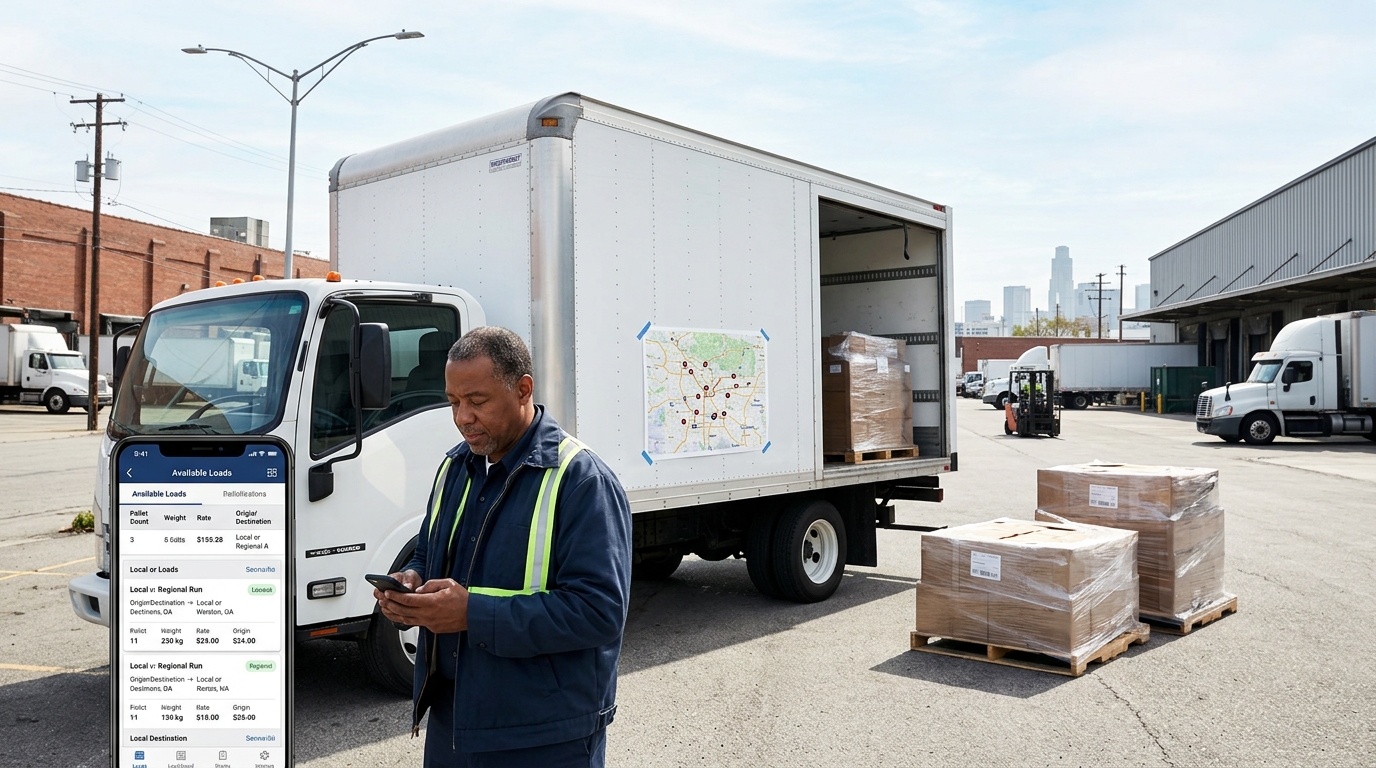
The Amazon Relay Trap
If you own a 26ft box truck, you have undoubtedly heard of Amazon Relay. It is the easiest entry point into the market. It requires minimal negotiation, the app is user-friendly, and the payment is guaranteed. However, relying solely on Amazon Relay is one of the fastest ways to bankrupt your box truck business. In an era where box truck load boards are saturated with cheap freight, you need a proactive box truck dispatching strategy to survive and thrive.
Amazon Relay is designed to benefit Amazon, not the owner-operator. The rates are highly commoditized, dropping significantly during off-peak seasons, and leaving you scrambling for miles just to break even. If your entire business model relies on waiting for a “good block” to drop on Relay, you are not running a business—you are playing a slot machine.
Understanding the True Box Truck Market
A 26ft box truck occupies a unique space in the logistics ecosystem. It is too small for standard full truckload (FTL) freight but perfectly sized for expedited freight, final-mile delivery, and Less-Than-Truckload (LTL) consolidation. To find high-paying loads, you must position your asset where it is most valuable.
The problem most box truck owners face is treating their equipment like a dry van. You cannot compete on a standard dry van load board because a shipper paying for 53 feet of space is not going to pay the same rate for 26 feet of space unless the freight is extremely time-sensitive. Therefore, your entire dispatching strategy must pivot away from “commodity freight” and toward “urgency and specialization.”
The Top Sources for High-Paying Box Truck Loads
1. LTL Consolidation
Less-Than-Truckload (LTL) freight is a goldmine for 26ft box trucks. Instead of looking for a single shipper to fill your truck, you find multiple shippers who need 2-4 pallets moved in the same general direction. By consolidating three separate shipments paying $1.50 per mile, you suddenly gross $4.50 per mile on the same lane. Effective box truck dispatching requires the operational bandwidth to coordinate multiple pick-ups and drop-offs efficiently.
2. Expedited Freight Networks
When an automotive manufacturing plant is short a specific part and risks shutting down the assembly line, they don’t care if a 53ft dry van or a 26ft box truck moves the freight. They care about speed. Expedited load boards (like Sylectus) are where the real money is made. To access these boards, you often need a proven track record, proper insurance limits, and impeccable communication. Building relationships with specialized expedited freight brokers is critical.
3. Trade Show and Event Logistics
Conventions, trade shows, and live events require precise, scheduled deliveries. These loads are often high-value, fragile, and absolutely cannot be late. Because of the strict delivery windows and the high stakes involved, the rates reflect a massive premium. Finding specialized brokers who deal in event logistics can yield rates exceeding $3.50+ per mile.
4. White Glove and Final Mile Delivery
If your box truck is equipped with a liftgate and you are willing to offer driver-assist or inside delivery, you open up a highly lucrative niche. High-end furniture, medical equipment, and electronics often require “white glove” service. While this is more labor-intensive, the margins are drastically higher than standard dock-to-dock freight.
How to Negotiate with Brokers as a Box Truck
When you call on a load posted on a standard load board (like DAT or Truckstop), the broker’s first question will be, “Are you a 53?” When you say you are a 26ft box truck, many brokers will immediately dismiss you. Here is how to counter that:
- Know the Freight Dimensions: Before you call, look at the weight and the commodity. If the load is 10,000 lbs and consists of 12 pallets, it fits perfectly in your truck.
- Sell Your Agility: Explain that unlike a 53ft trailer, your box truck can navigate tight city streets, back into difficult docks, and handle expedited urban deliveries with ease.
- Offer Dedicated Service: Standard LTL carriers (like FedEx Freight or Old Dominion) have long transit times due to their hub-and-spoke models. Offer the broker “dedicated LTL” service—straight from the shipper to the receiver without cross-docking, reducing the risk of damage and significantly cutting transit time.
The Financial Realities of Box Truck Dispatching
Running a box truck is generally cheaper than running a Class 8 semi. Your fuel efficiency is better (often 8-10 MPG compared to 6-7 MPG), maintenance costs are slightly lower, and insurance premiums can sometimes be more favorable. However, because gross revenue per load is generally lower, your margin for error is razor-thin.
To maximize profitability, you must eliminate deadhead. Triangle routing is essential. If you take a load from Atlanta to Chicago, you must immediately have a consolidated LTL load or an expedited partial booked out of Chicago heading to Nashville, and then back to Atlanta. Empty miles destroy box truck businesses faster than anything else.
Conclusion: Elevate Your Dispatch Strategy
Moving away from Amazon Relay and tapping into the broader, higher-paying market requires skill, patience, and a deep understanding of box truck load boards and logistics. If you do not have the time to sit on the phone, negotiate with brokers, and coordinate LTL consolidations, you need a dedicated dispatch team. At Empire Dispatch, we specialize in maximizing revenue for 26ft box trucks by focusing on expedited freight, partials, and dedicated lanes. Stop hauling cheap freight and start realizing the true value of your equipment.
Leave a Reply